Independent products · built and shipped outside my full-time role
Products I've built and shipped.
Three live products where I owned everything: the problem, positioning, scope, AI design and the build itself.
RankFlowHQ
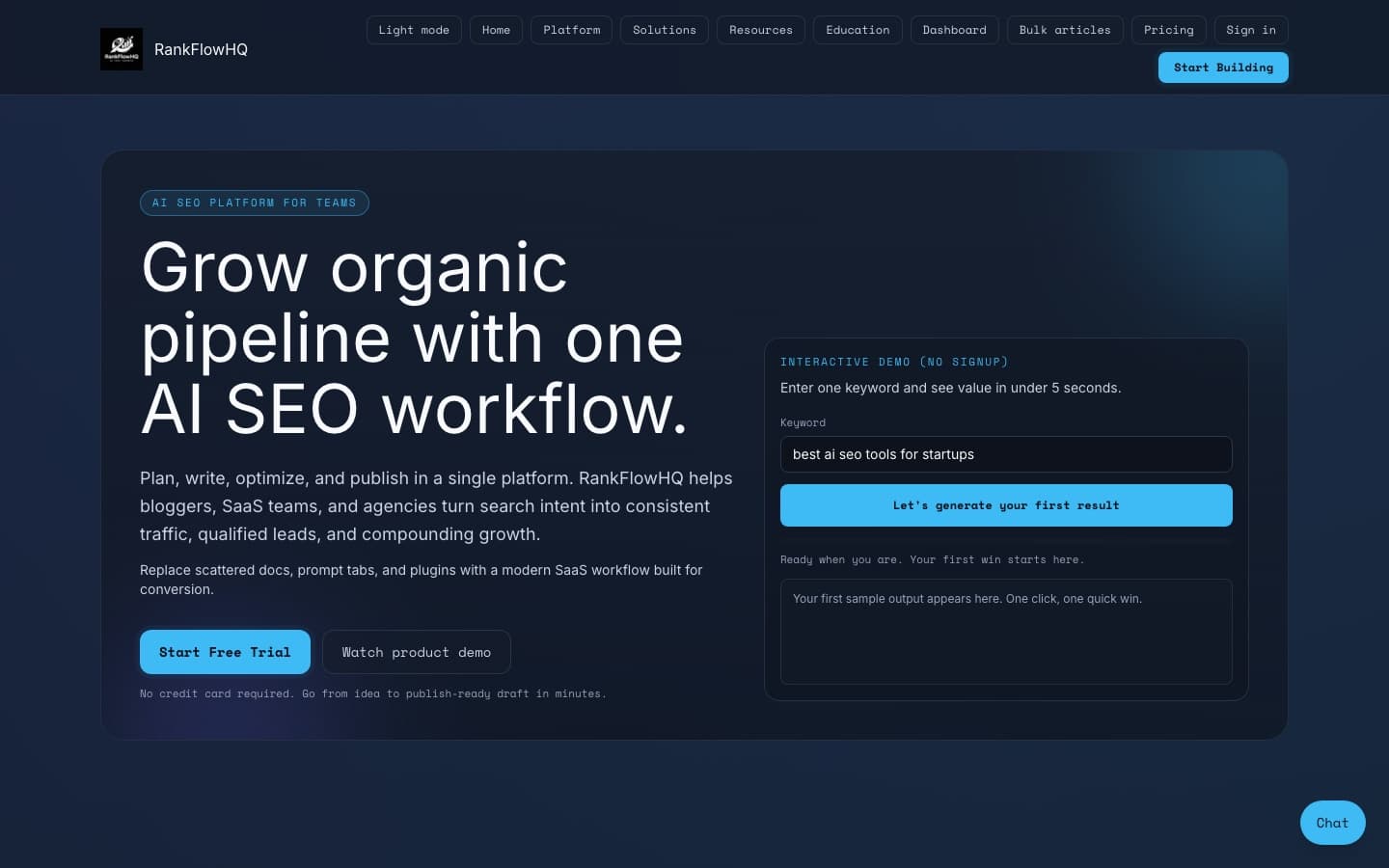
An AI SEO workflow that takes a keyword to a publish-ready, cited article in one guided pipeline.
Problem
SEO teams stitch together chat prompts, keyword tools, optimizers and docs. Handoffs are slow, quality is inconsistent, and nothing scales past a few articles a week.
Who it's for
Bloggers, SaaS content teams and SEO agencies.
How it works
01
Keyword
02
Clustering & intent
03
SERP research
04
Outline
05
Cited draft
06
SEO packaging
01
Keyword
02
Clustering & intent
03
SERP research
04
Outline
05
Cited draft
06
SEO packaging
What's live
- No-signup interactive demo: one keyword in, a first result in seconds
- Full SEO article agent and a bulk article agent that saves drafts to the user's account
- Keyword clustering for topic and SERP planning
- Search visibility grader
- Output packaged with FAQs, internal links and SEO title/description
Product decisions
A pipeline, not a chat box
ChatGPT is great for brainstorming but has no repeatable process. I structured RankFlowHQ as fixed stages (research → outline → draft → audit) so every article meets the same standard and can be produced at volume.
Time to value under a minute
The homepage demo needs no signup: enter one keyword and see output straight away. For a new AI tool, trust comes from seeing a real result before handing over an email.
Grounding over fluency
Drafts are built from SERP and research inputs with citations, rather than the model's memory, to reduce confident-but-wrong content, the main failure mode of AI writing tools.
Positioned against the workflow, not one feature
Surfer scores a page and Jasper writes copy. RankFlowHQ's positioning is running the whole program, from research to published page.
RankFlowHQ Education Hub
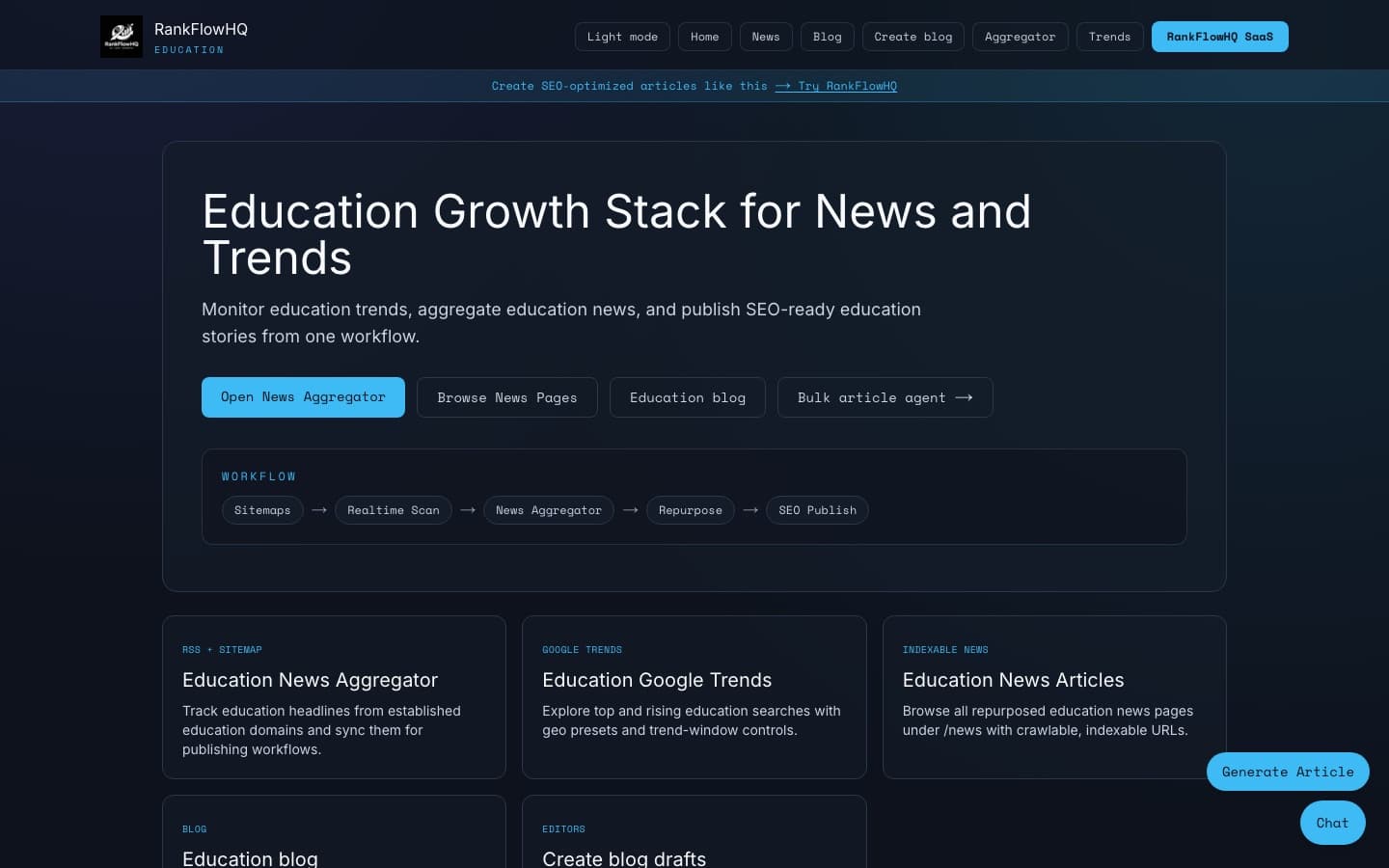
An automated news and trends stack that turns education headlines into indexable, SEO-ready stories.
Problem
Education news moves fast. Editorial teams manually check sources, miss trending searches, and publish too late to rank.
Who it's for
Education publishers and content editors. It is also a live showcase of RankFlowHQ's pipeline in a vertical I know well.
How it works
01
Sitemaps & RSS
02
Real-time scan
03
News aggregator
04
AI repurpose
05
SEO publish
01
Sitemaps & RSS
02
Real-time scan
03
News aggregator
04
AI repurpose
05
SEO publish
What's live
- News aggregator tracking established education domains via RSS and sitemaps
- Education Google Trends explorer with geo presets and trend windows
- Repurposed news published as crawlable, indexable pages under /news
- Editor workspace to bulk-create and manage blog drafts
Product decisions
Dogfooding in my own domain
I applied the RankFlowHQ engine to education, where I've spent 5 years building SEO and content platforms, so I could judge output quality like an expert instead of guessing.
Trends drive the queue
Pairing the aggregator with Google Trends means editors prioritize stories people are actively searching for, not just whatever was published most recently.
HarshOnRoads
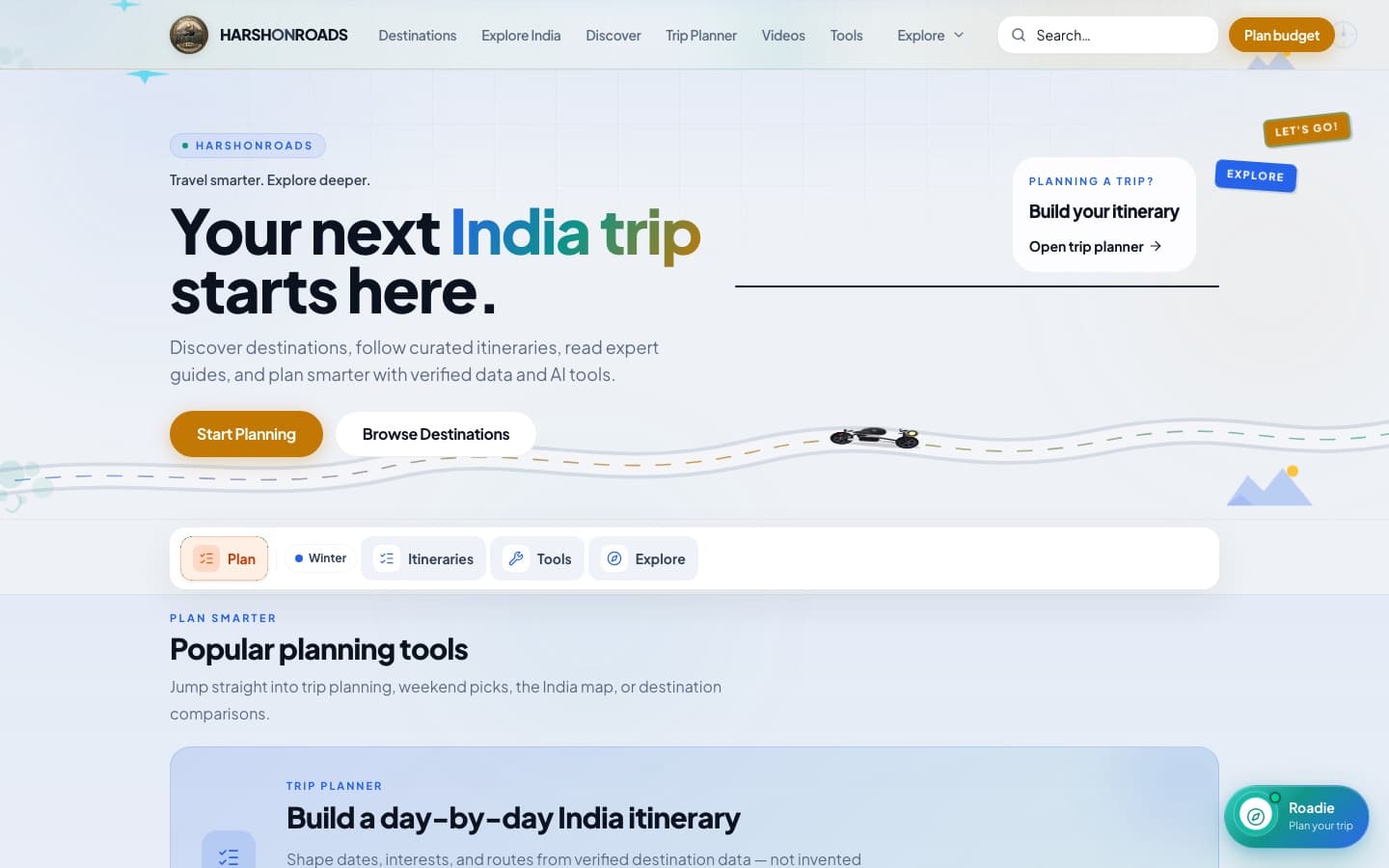
An India trip planner that builds itineraries from verified destination data first, and clearly labels anything AI-researched.
Problem
Generic AI trip planners hallucinate places, timings and distances. Travelers need plans they can actually drive.
Who it's for
Weekend travelers and road-trippers in India, especially from Delhi NCR.
How it works
01
Budget, days & style
02
Verified destination data
03
Ranking & matching
04
Day-by-day itinerary
01
Budget, days & style
02
Verified destination data
03
Ranking & matching
04
Day-by-day itinerary
What's live
- AI trip planner: day-by-day itineraries from verified places (AI-researched plans for other cities are clearly labelled), with route map, drive times, plain-language edits, English and Hindi
- Weekend finder ranking destinations by budget, days, distance, transport and travel style
- Interactive India map with seasons and quick facts
- Side-by-side destination comparison on distance, budget, season and editorial scores
- Curated itineraries and a season-by-season guide
- Distribution through my own travel channels: 264+ YouTube Shorts and Instagram as @harshonroads
Product decisions
Verified data first, labelled AI fallback
For verified destinations, the planner may only use places in the verified database, so it can't invent an attraction. For other cities it still produces a plan, clearly marked as AI-researched, so users know how far to trust it.
Content as the acquisition channel
I create the travel content myself (264+ Shorts on YouTube and Instagram), so the product grows on its own distribution instead of paid acquisition. Every trip becomes both a video and a verified itinerary.
Structured tools beside the AI
Not every question needs an LLM. The weekend finder, map and compare tool are deterministic, so they're fast and predictable, with AI used where it adds value.