Case study
RankFlowHQ: building a grounded AI SEO product, solo
I designed, built and launched RankFlowHQ on my own: a Generative AI workflow that takes a keyword to a cited, publish-ready article. The product decisions were about trust, time-to-value and positioning, not just prompts.
At a glance
- Role
- Founder-PM: product, design and build
- Company
- Independent product
- Timeline
- Independent · live and ongoing
- Team
- Solo (AI-assisted coding)
- 0→1
- idea to live product, solo
- 6
- pipeline stages, keyword to publish
- 0
- signups needed to see a first result
- 3
- live AI products I have shipped
Summary
SEO teams juggle chat prompts, keyword tools, optimisers and docs, and still struggle to publish consistently good pages at volume. I built RankFlowHQ to run the whole program in one guided pipeline: keyword → clustering → research → outline → cited draft → SEO packaging. I owned every part: the problem, positioning, scope, AI design, UX and the build. It's live at rankflowhq.com, with an Education Hub that runs the same engine on education news.
Context
I spent 5 years building SEO and content platforms at Collegedunia and KollegeApply, including scaling a site to 300K+ indexed pages. I saw the same pattern everywhere: AI made writing cheap, but publishing good pages consistently was still slow, because research, structure, accuracy and on-page standards lived in people's heads and in scattered tools.
The problem
- Fragmented workflow: keyword research in one tool, briefs in docs, drafts in a chat window, optimisation in a plugin. Every handoff costs time.
- Inconsistent quality at volume: each writer and each prompt produces a different structure, so rankings suffer as output scales.
- Trust: generic AI writing confidently invents statistics and facts. An SEO page with a fabricated number is a liability, not an asset.
Users
- Bloggers and niche site owners: publish quality pages faster without juggling tools.
- SaaS content teams: turn product expertise into SEO pages on a steady cadence.
- Agencies: standardise production across clients to improve turnaround and margins.
Options considered
A better prompt library on top of ChatGPT
Fast to build, but it doesn't fix the workflow: no research step, no structure standards, no packaging, and no protection against invented facts. Rejected: it competes with a free tool on that tool's own ground.
An optimisation score for existing pages (like Surfer)
Useful, but it only tunes pages that already exist. Users still have to research and write. Rejected as the core, though a visibility grader became a supporting tool.
An end-to-end, grounded production pipeline
Chosen
Harder to build, but it owns the whole job from keyword to publish-ready page, and grounding gives a clear quality edge over generic AI writing. Chosen.
What I built
1. A staged pipeline instead of a chat box. Every article goes through the same stages: keyword and intent-aligned supporting terms → clustering → SERP research → outline → draft with citations → SEO packaging (title, meta description, FAQs, internal links). Fixed stages make quality repeatable and debuggable: when an output is weak, I can see which stage failed.
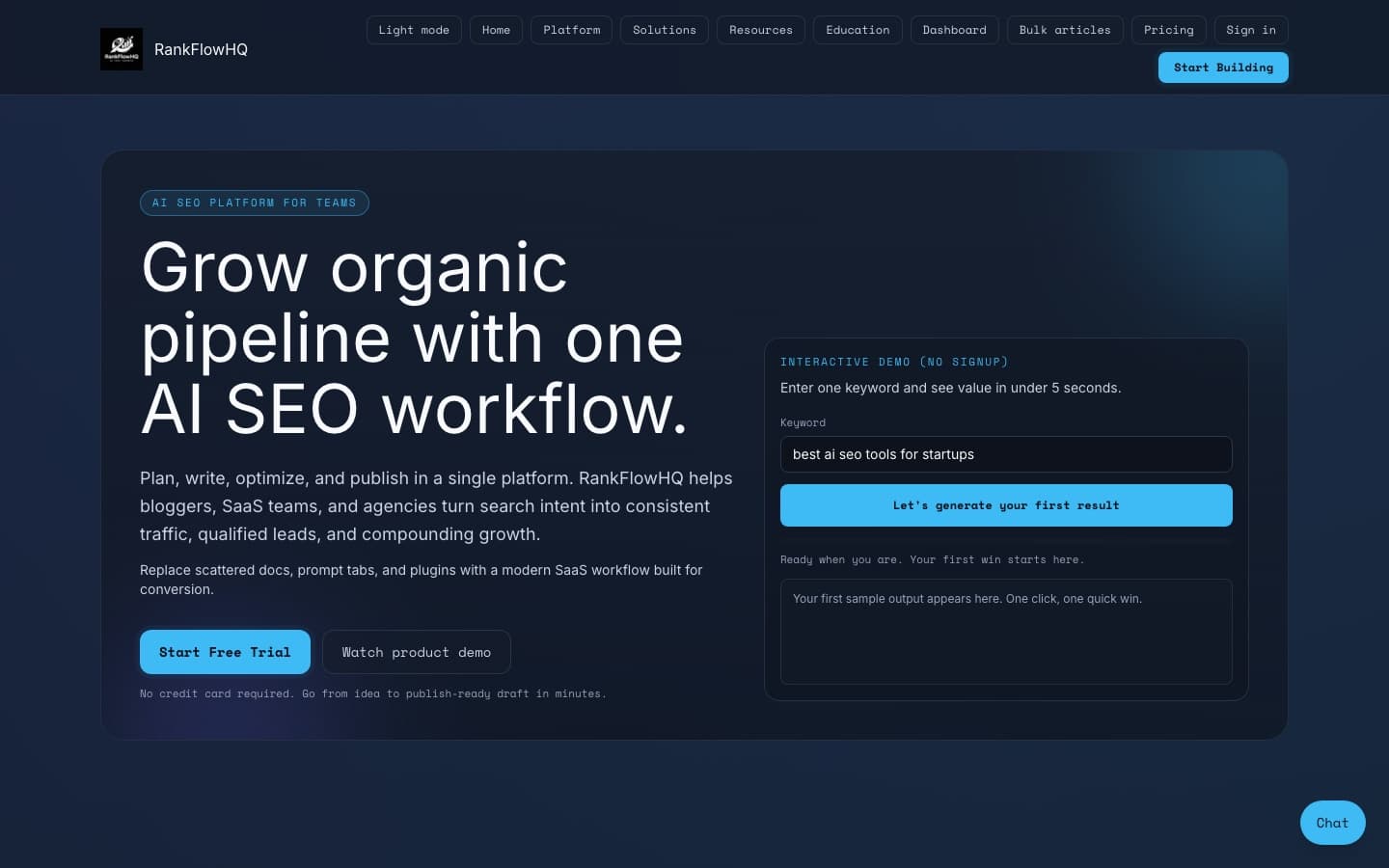
2. Time-to-value before signup. The homepage has an interactive demo: enter one keyword and see output right away, no account needed. A sample of a full keyword → outline → article run is shown on the page too.
3. Tools for volume. A bulk article agent runs the pipeline on many topics and saves drafts to the user's account; keyword clustering supports topic planning; a search visibility grader checks existing pages.
4. Dogfooding in a vertical I know. The Education Hub applies the engine to education news: RSS and sitemap aggregation, a Google Trends explorer, AI repurposing and indexable news pages. Education is the domain I've worked in for 5 years, so I can judge output quality like an expert.
Positioning
| Alternative | What it does | RankFlowHQ's angle |
|---|---|---|
| ChatGPT | Brainstorming and one-off drafts | A repeatable publishing pipeline with standards |
| Surfer SEO | Scores and tunes an existing page | Runs the program: research → production → optimisation |
| Jasper | Marketing copy | Built for search outcomes: intent, structure, clusters |
Trade-offs
How I evaluate it
I use the framework from my article How I evaluate LLM features before they ship: pass/fail criteria (correct, complete, structured, usable), a test set of typical, hard and adversarial keywords, failure modes grouped by cause, and cost per good article rather than per request.
What I learned
- Distribution is part of the product. Building it was the easier half; getting the right users to try it is the harder one. That's why the no-signup demo and the Education Hub exist.
- The pipeline is the moat, not the model. Models improve for everyone. Research quality, structure standards and grounding are what make the output consistently publishable.
- Being my own first user is an advantage. Years of running SEO platforms meant I knew which outputs would actually rank and which would only look good.
What's next
- Publish a formal evaluation report (pass rate, unsupported-claim rate, cost per article).
- Track activation: the % of demo users who run a full article.
- Learn from user edits: feed corrected drafts back as examples to improve future output.